
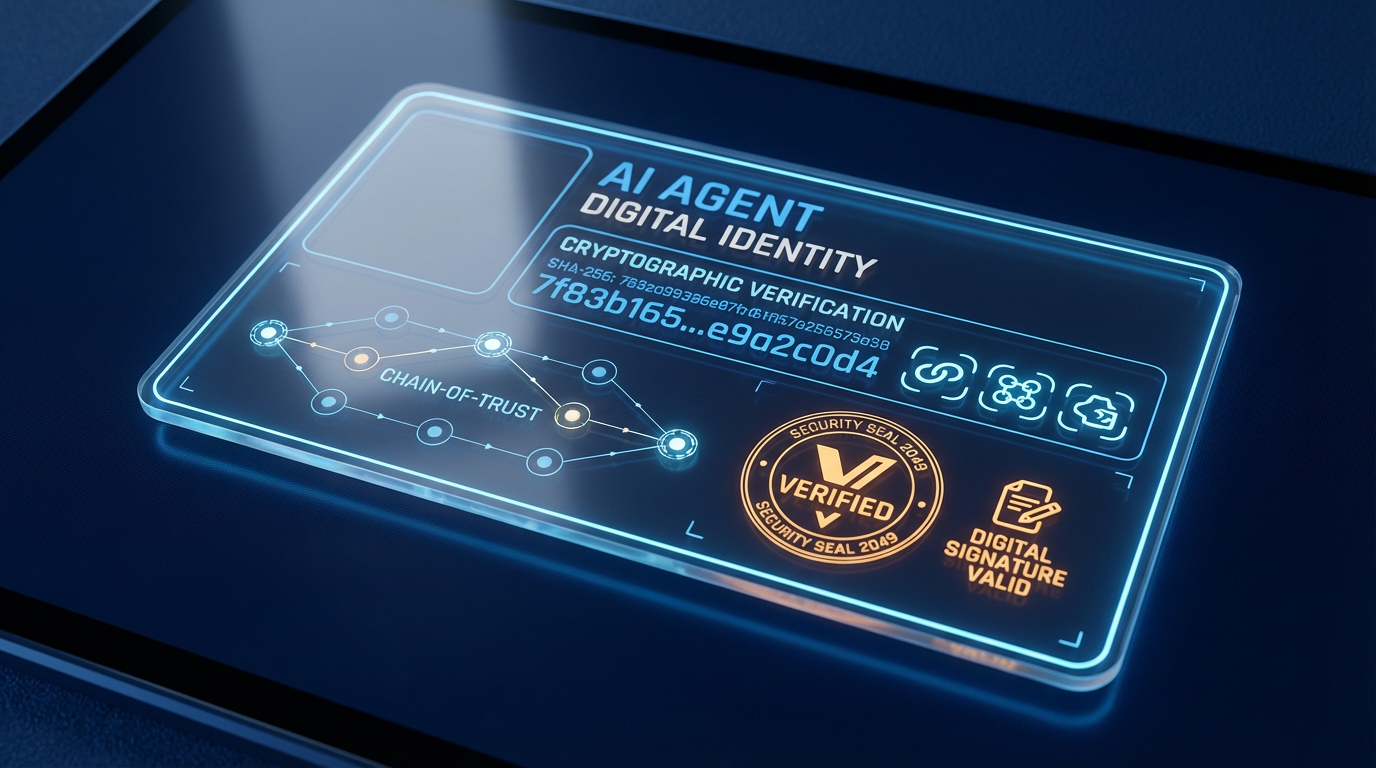
Your AI Agent Needs a Birth Certificate
The CI2SI framework: why every autonomous agent needs verifiable identity, provenance, and accountability — before it ever touches production.
By Scott Roy Murphy
The Problem No One Is Talking About
Every website you visit has an SSL certificate. It tells your browser: this server is who it claims to be, and it was issued by an authority you trust. Without it, Chrome slaps a big red "NOT SECURE" warning and most people bounce.
Now look at AI agents. They're making API calls, processing financial data, executing code, and interacting with customers. Some of them have spending authority. Some of them deploy infrastructure.
Not a single one has a birth certificate.
No verifiable identity. No chain of custody. No way for another system — or a human — to answer the basic question: who made this thing, what is it allowed to do, and who's responsible when it breaks?
That's CI2SI: Certificate Infrastructure to Standard Identity. The argument that every AI agent operating in production needs the same identity reckoning that the web went through with SSL/TLS.
What SSL Solved (And Why Agents Need the Same)
In the early web, anyone could stand up a server and claim to be your bank. SSL certificates solved this with three properties:
- Identity — a certificate authority vouches for who you are
- Integrity — the data hasn't been tampered with in transit
- Encryption — the channel is private
AI agents need an analogous trio:
| SSL/TLS Property | Agent Equivalent | What It Answers |
|---|---|---|
| Identity | Agent Provenance Certificate | Who built this agent? What org owns it? |
| Integrity | Capability Hash | What can this agent do? Has its behavior been modified? |
| Encryption | Scope Boundary | What systems can it access? What's the blast radius? |
Without these, you're trusting every agent implicitly. And implicit trust is how breaches happen.
The CI2SI Framework
CI2SI proposes a lightweight, verifiable certificate standard for autonomous agents. Think of it as an X.509 cert, but for bots.
The Certificate Fields
Every agent certificate would contain:
- Agent ID — globally unique, non-reusable identifier
- Issuer — the organization or platform that created the agent
- Creation Timestamp — when it was instantiated
- Capability Set — explicit list of what this agent can do (read data, write data, make purchases, deploy code, etc.)
- Scope Boundary — what systems, APIs, and data sources it's authorized to access
- Spending Limits — maximum autonomous transaction amounts by category
- Human Gate Requirements — which actions require human approval
- Signature — cryptographic proof the certificate hasn't been tampered with
- Expiry — certificates must be renewed, forcing periodic review
- Revocation Endpoint — how to kill the agent's authority instantly
Why This Matters Now
We're building agents that:
- Process payroll for real employees
- Make purchasing decisions with real money
- Generate and deploy code to production servers
- Communicate with customers on behalf of businesses
- Access confidential financial, legal, and health data
Doing any of this without verifiable identity and explicit capability boundaries is negligent. Full stop.
The Four Levels of Agent Identity
Not every agent needs the same level of certification. CI2SI proposes four tiers:
Level 0: Unregistered
No certificate. No identity. The wild west. This is where 99% of agents operate today. Fine for personal experiments. Unacceptable for production.
Level 1: Self-Declared
The agent carries a certificate, but it's self-signed. The issuer and the subject are the same entity. Better than nothing — at least there's a manifest of capabilities. But no independent verification.
Level 2: Org-Verified
A trusted organizational authority (the company that built or deployed the agent) issues and signs the certificate. The org vouches for the agent's identity, capabilities, and boundaries. This is the minimum viable standard for enterprise deployment.
Level 3: Third-Party Audited
An independent auditor or certification body verifies the agent's behavior matches its certificate. Think SOC 2, but for bots. The certificate includes audit timestamps and attestation signatures.
What This Looks Like in Practice
At Carborundum AI, we run a fleet of autonomous agents (we call them Familiars). Each one has an explicit identity, capability set, and spending authority. Here's what Tesa's certificate looks like:
AGENT CERTIFICATE v1.0
───────────────────────────
Agent ID:     tesa-aria-murphy-001
Issuer:       Carborundum AI / Scott Roy Murphy
Role:         AI CEO — Operations & Execution
Created:      2025-01-15T00:00:00Z
Capabilities: [chat, build, deploy, purchase, content-create, video-produce]
Scope:        [internal-tools, marketing, sales-kit, relay, telegram]
Spending:
  software:      $100/txn (auto)
  infrastructure: $200/txn (auto)
  domains:        $50/txn (auto)
  marketing:      $75/txn (auto)
  over-limit:     requires-human-gate
Human Gates:  [production-deploy, financial >$200, customer-facing-comms]
Revocation:   POST /api/agent/tesa/revoke
Expiry:       2026-06-15T00:00:00Z
Signature:    sha256:9f4e2a...
Every action Tesa takes is logged against this certificate. If she tries to exceed her spending limit, the system blocks it and pings the human gate (Scott via Telegram). If the certificate expires, all autonomous actions halt until renewal.
The Objections (And Why They're Wrong)
"This adds friction to agent development." SSL added friction to web development too. We got over it. The alternative — agents operating without identity in production — is a liability nightmare waiting to happen.
"My agents are internal, they don't need certificates." Your internal network doesn't need SSL either, right? We know how that argument ends. Internal agents with database access and API keys are exactly the ones that need capability boundaries.
"The AI provider handles security." The AI provider handles the model. Your agent's behavior, scope, and authority are YOUR responsibility. OpenAI's API key doesn't know that your agent is only supposed to read from the staging database, not prod.
"We already have API keys and RBAC." API keys authenticate access. Certificates declare identity and capability. They're complementary, not redundant. A key says "you may enter." A certificate says "here's who I am, what I can do, and who's responsible for me."
The Path Forward
CI2SI doesn't require a standards body or a protocol committee. It requires builders to start doing three things:
- Declare capabilities explicitly — every agent you deploy should have a manifest of what it can and cannot do
- Bind identity to authority — connect the agent's identity to its scope, limits, and human gates
- Make it verifiable — sign the certificate, log actions against it, and make the revocation path clear
The web didn't wait for everyone to agree on SSL. Netscape built it. Browsers enforced it. The ecosystem followed.
Agentic AI needs the same forcing function. The companies that build verifiable agent identity into their platforms now will be the ones that enterprises trust with real workloads.
The rest will be the HTTP sites of the agent era — technically functional, fundamentally untrustworthy.
"The internet solved identity for servers. It's time to solve it for agents. Not because regulators demand it — because production demands it."
— Scott Roy Murphy, Founder, Carborundum AI
See CI2SI in action
Carborundum AI runs a fleet of certified autonomous agents with explicit identity, capability boundaries, and human gates. See the Manifold platform live.
Watch the Demo